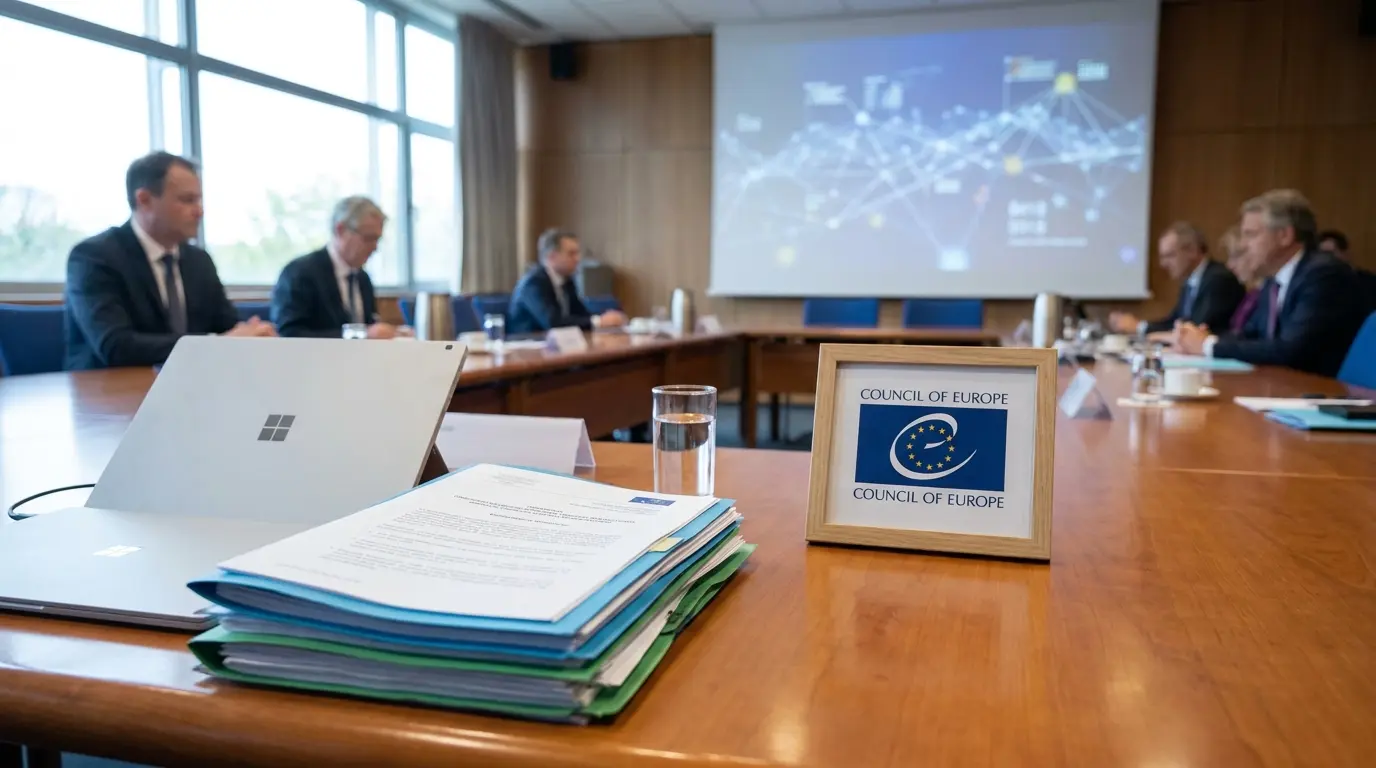

Artificial intelligence is moving fast, and the governance frameworks meant to guide it are struggling to keep pace. That critical gap sits at the center of the new Council of Europe Microsoft AI agreement, uniting an international human rights body with one of the world’s most influential technology firms. Together, both organizations seek to guarantee that artificial intelligence advances in a manner that protects human rights, democracy, and the foundational rule of law.
The formal signing ceremony took place at the Council of Europe’s headquarters located in Strasbourg, France. Secretary General Alain Berset finalized the memorandum alongside Brad Smith, who serves as the Vice Chair and President of Microsoft. Both leaders emphasized that technologies possessing this level of transformative capability demand unified, international rules established without delay.
So what does this landmark Council of Europe Microsoft AI agreement actually establish, and why does it matter? This analysis details the strategic partnership in clear terms, examines the prior collaboration between both entities, and outlines the practical implications for everyday digital technologies.
To understand the scope, one must examine the specific instrument used. The document signed in Strasbourg is a formal memorandum of understanding, commonly designated as an MoU. Rather than binding participants to a rigid list of commercial deliverables, it establishes an open framework for structured bilateral cooperation on artificial intelligence governance.
That procedural distinction carries considerable practical importance for both parties. Any specific project conducted under this framework requires direct bilateral consent and must remain within the established statutory boundaries of each institution. Consequently, neither entity has committed to financing, engineering, or releasing specific algorithms or software tools at this stage.
An MoU is not an enforceable commercial contract with guaranteed deliverables. Instead, consider it a formalized diplomatic baseline that creates operational protocols for future joint initiatives. Its tangible value will depend upon the specific operational programs approved in subsequent phases.
Despite its non-binding nature, the core mandate of the memorandum remains broadly ambitious. The bilateral initiative prioritizes safeguarding human rights and democratic institutions through equitable, responsible technological innovation. Furthermore, it addresses procedural integrity within digital spaces that continue to undergo rapid systemic evolution.
Because the Council of Europe Microsoft AI agreement acts primarily as a governance blueprint, consumers will not witness immediate product modifications. Over time, however, the arrangement will foster joint research, policy advisories, and ethical guardrails across generative systems. Establishing systemic norms before deployment accelerates represents the primary objective of this institutional accord.
- The Council of Europe Microsoft AI agreement functions as a memorandum of understanding setting terms for future joint policy efforts.
- Human rights, democracy, and rule of law remain the core priorities governing the bilateral framework.
- All individual initiatives under the pact require bilateral consent and must align with organizational mandates.
AI Governance Urgency: Why Leaders Say AI Needs Rules Right Now

Secretary General Alain Berset delivered an urgent message during the formal signing event. “Disregard for international law has caused the rupture in the world order,” he stated plainly. “AI is arriving in the middle of that rupture, with force taking the place of shared rules.”
His commentary centered upon the velocity of contemporary machine learning advancements. Berset observed that no historical innovation has required regulatory oversight as acutely, because algorithmic systems outpace traditional democratic checks. Partnering with major industry enterprises remains necessary, he argued, so institutions can guide technical evolution along a safe trajectory.
Scrutiny surrounding frontier model governance extends far across the international regulatory landscape. Antitrust and legal authorities have stepped up reviews, and the EU has scrutinized AI agreements involving Microsoft, OpenAI, Google, and Samsung as part of broader enforcement. Public sector officials want active oversight before commercial architectures become entrenched standards.
Concurrently, private technology giants continue committing massive capital to artificial intelligence ecosystems. Notably, Bill Gates called AI “the hottest topic of 2023” in a Forbes interview about advising OpenAI and Microsoft. High-velocity commercial scaling inevitably demands greater interaction with intergovernmental treaty organizations dedicated to public welfare.
Responsible AI Roadmap: What the Partnership Could Do Next

The memorandum identifies multiple priority domains for constructive technological cooperation between both entities. While none constitute binding obligations immediately, they indicate where collaborative resources will focus. The shared roadmap highlights mutual priorities across three principal areas of application.
Dialogue Through the Open Innovation Centre
Initial consultations will center around Microsoft’s Open Innovation Centre based locally in Strasbourg. The memorandum cites collaborative exchanges at this technical facility as an organic starting point for operational execution. Operating an innovation hub within close proximity to treaty headquarters creates continuous opportunities for meaningful policy coordination.
Sharing Knowledge on Responsible Development
Both signatories plan to pool strategic research concerning responsible, ethically constrained machine intelligence models. This initiative emphasizes equitable access strategies designed to distribute modern technological dividends widely. For an organization representing 46 sovereign member states, establishing harmonized principles helps elevate regional policy standards.
Protecting Linguistic and Cultural Diversity
Cultural preservation receives explicit attention within the text of the memorandum. The provisions authorize collaborative programs dedicated to linguistic pluralism, with special support targeted toward regional and minority languages. Such interventions remain crucial since modern foundation models routinely marginalize low-resource linguistic communities.
To observe tangible outcomes, monitor ongoing joint communiqués from the Council of Europe alongside Microsoft’s Open Innovation Centre. Because project activations require dual approval, formal press updates will disclose the earliest operational implementations.
Public-Private Collaboration: The Track Record Behind the Deal
The Council of Europe Microsoft AI agreement expands upon years of verified institutional teamwork. Rather than establishing fresh channels, the memorandum formalizes pre-existing administrative relationships. Two ongoing international initiatives illustrate how this public-private dynamic delivers functional results.
The Register of Damage for Ukraine
The memorandum expands cooperative analytics supporting the Register of Damage for Ukraine. Established to document devastation stemming from Russian aggression, this mechanism compiles evidence required for international reparations claims. Crucially, Microsoft’s AI for Good Lab contributes technical modeling for damage documentation protocols, which authorities deem vital.
Synthesizing large-scale regional devastation represents an ideal operational environment for specialized analytical systems. Massive volumes of satellite observations, ground reports, and digital records quickly overwhelm manual evaluation teams. Automated analytical pipelines accelerate documentation timelines that would otherwise occupy legal investigators for years.
Years of Cybercrime Cooperation
Both organizations also maintain sustained partnerships addressing international digital crime prevention. Microsoft has consistently aided the Council of Europe’s Budapest Convention on Cybercrime through the Cybercrime Octopus framework. That multilateral convention represents one of the premier legal standards enabling cross-border judicial assistance.
Past technical engagements balanced two critical public interest goals simultaneously. First, programs assisted member jurisdictions in adopting international treaty standards directly into domestic legislation. Second, efforts reinforced data protection and statutory civil protections, balancing law enforcement powers with core civilian privacy rights.
- The strategic accord expands existing institutional programs rather than building relationships from scratch.
- Microsoft’s AI for Good Lab contributes critical analytical tooling to the Register of Damage for Ukraine.
- Past joint actions advanced the Budapest Convention on Cybercrime while preserving civil liberties and procedural privacy.
Consumer Impact: What This Means for Everyday People
Citizens detached from high-level European policymaking might reasonably question the immediate consumer relevance of these talks. Why should non-specialists care about a diplomatic memorandum drafted in Strasbourg? The reality is that international accords establish baseline technical expectations that gradually dictate consumer product safety.
Brad Smith underscored this human-centric objective during the public proceedings. “AI is creating extraordinary opportunities, but its success will ultimately be measured by how well it serves people,” he remarked. He highlighted this collaboration as concrete evidence that cutting-edge software development can respect constitutional freedoms and procedural accountability.
Broader economic dynamics further underscore the relevance of the Council of Europe Microsoft AI agreement. Commercial leaders continue consolidating model infrastructure at unprecedented rates, an evolution Gates analyzed during his Forbes conversation about Microsoft and OpenAI. Direct multi-stakeholder participation ensures democratic protections inform corporate engineering decisions instead of remaining secondary corporate considerations.
Frequently Asked Questions
What is the Council of Europe Microsoft AI agreement?
The Council of Europe Microsoft AI agreement is a memorandum of understanding signed in Strasbourg establishing a collaborative framework for human rights protection, democracy, and responsible artificial intelligence development. Any specific work requires mutual consent and must fit each entity’s mandate.
Is the agreement legally binding?
No, the memorandum establishes an operational framework rather than binding contractual obligations. It functions primarily as an institutional baseline for structured future cooperation rather than a commercial contract with fixed deliverables.
Who signed the agreement?
Alain Berset, Secretary General of the Council of Europe, and Brad Smith, Vice Chair and President of Microsoft, executed the document. The signing ceremony took place at the Council’s headquarters in Strasbourg, France.
What projects might the partnership cover?
Potential focus areas include dialogues via Microsoft’s Open Innovation Centre in Strasbourg, knowledge exchanges on ethical AI governance, and collaborative projects defending linguistic and cultural diversity, particularly for regional languages.
Have the Council of Europe and Microsoft worked together before?
Yes, their prior history includes longstanding cooperation on the Budapest Convention on Cybercrime via the Cybercrime Octopus initiative. Additionally, Microsoft’s AI for Good Lab contributes technical support to the Register of Damage for Ukraine.
What is the Register of Damage for Ukraine?
It is an intergovernmental mechanism documenting war damages caused by the Russian invasion of Ukraine. Microsoft’s AI for Good Lab provides satellite and evidentiary data modeling to support the Council’s assessment efforts.
Does this agreement change the Microsoft products you use?
Not immediately. The Council of Europe Microsoft AI agreement focuses on structural governance and ethical principles, which will subtly influence consumer software standards and policies over an extended horizon.
The Bottom Line on the Council of Europe Microsoft AI Agreement
The Council of Europe Microsoft AI agreement highlights a growing consensus that institutional cooperation serves the public interest better than fragmented confrontation. By establishing a shared baseline grounded in democracy, fundamental freedoms, and legal oversight, both parties aim to shape algorithmic safety proactively. This strategic accord builds upon tested joint initiatives, including cybercrime prevention and humanitarian damage tracking in Ukraine.
Ultimately, this memorandum provides a viable foundation rather than a definitive regulatory endpoint. The practical success of the pact relies entirely upon the specific technical projects both sides choose to execute. For global governance, the alliance signals that major technology developers and historic democratic institutions recognize the necessity of collaborative AI guardrails.