
Imagine an elderly patient in a rural community who has never used a smartphone, cannot read a formal health portal, and speaks a local dialect no app understands. Now picture that patient simply picking up a landline, speaking naturally, and being guided through booking, triage, and follow-up care. That is the promise of Voice AI in Healthcare, and a new initiative in Israel shows where it is heading.
Table of contents
- Why Voice AI Matters in Healthcare Right Now
- Inside the Digital Front Door Project
- The Technology Stack
- Why Telephony Is the Deliberate Choice
- Dialect-Tuned Speech and the Accessibility Advantage
- Why Dialect Support Is Hard
- Privacy and Zero-Trust Security
- From Proprietary Tools to Open-Source Health AI
- What the Open-Source Release Could Enable
- The Challenges Voice AI in Healthcare Must Overcome
- Latency and Conversation Flow
- Reliability and Misinformation
- Ethics and the Human Relationship
- Lessons for Health Systems Considering Voice AI
- Frequently Asked Questions
- What is the Digital Front Door voice AI assistant?
- Who can use the Clalit voice assistant?
- How does the system handle patient privacy?
- Will the technology be available outside Israel?
- What are the main risks of voice AI in healthcare?
- Why is dialect support so important for healthcare voice AI?
- Conclusion: A Model for Inclusive Healthcare AI
Google.org has awarded a $2 million, two-year grant to Clalit Health Services, Israel’s largest healthcare organization, to build a conversational voice AI platform called the “Digital Front Door.” Combining Google Gemini large language models with Google Cloud infrastructure, it guides patients through intake, triage, booking, and follow-up via ordinary phone calls, with dialect-aware speech recognition, strict privacy protections, and an open-source architecture.
Here is how the Digital Front Door works, why phone-first voice AI may answer healthcare’s digital divide, and what other health systems can learn.
Why Voice AI Matters in Healthcare Right Now
Health care faces a persistent paradox: digital tools have multiplied, yet many patients remain excluded. Online portals assume literacy, internet access, and digital confidence, quietly shutting out people who communicate primarily in spoken dialects rather than formal written language.

Voice AI offers a different path: speech requires no literacy, smartphone, or training. Research describes clinical speech AI as a scalable, low-burden assessment tool, and a scoping review of automatic speech recognition in healthcare in the post-LLM era found administrative documentation the most common application among nineteen studies, followed by diagnosis, therapy, and doctor-patient communication, evidence that the field is maturing toward conversational use cases.
Generative AI voice agents accelerate this shift. Unlike pre-coded chatbots, they draw on large language models trained on medical literature and anonymized transcripts to generate context-aware responses in real time. A perspective on how generative AI voice agents will transform medicine argues they could become a critical extension of the care team, increasing clinician reach beyond human resource limits.
Key takeaways
→ Voice AI removes literacy, smartphone, and internet barriers that exclude many patients from digital health services.
→ Research shows administrative documentation is currently the most common healthcare speech AI application, with conversational use cases growing.
→ Generative AI voice agents differ from older chatbots by generating context-aware responses rather than following rigid scripts.
Inside the Digital Front Door Project
The Digital Front Door answers a practical question: how do you deliver intelligent health care navigation to an entire population, including those the digital world left behind? Clalit, Israel’s largest provider, received $2 million over two years from Google.org to build it.
The Technology Stack
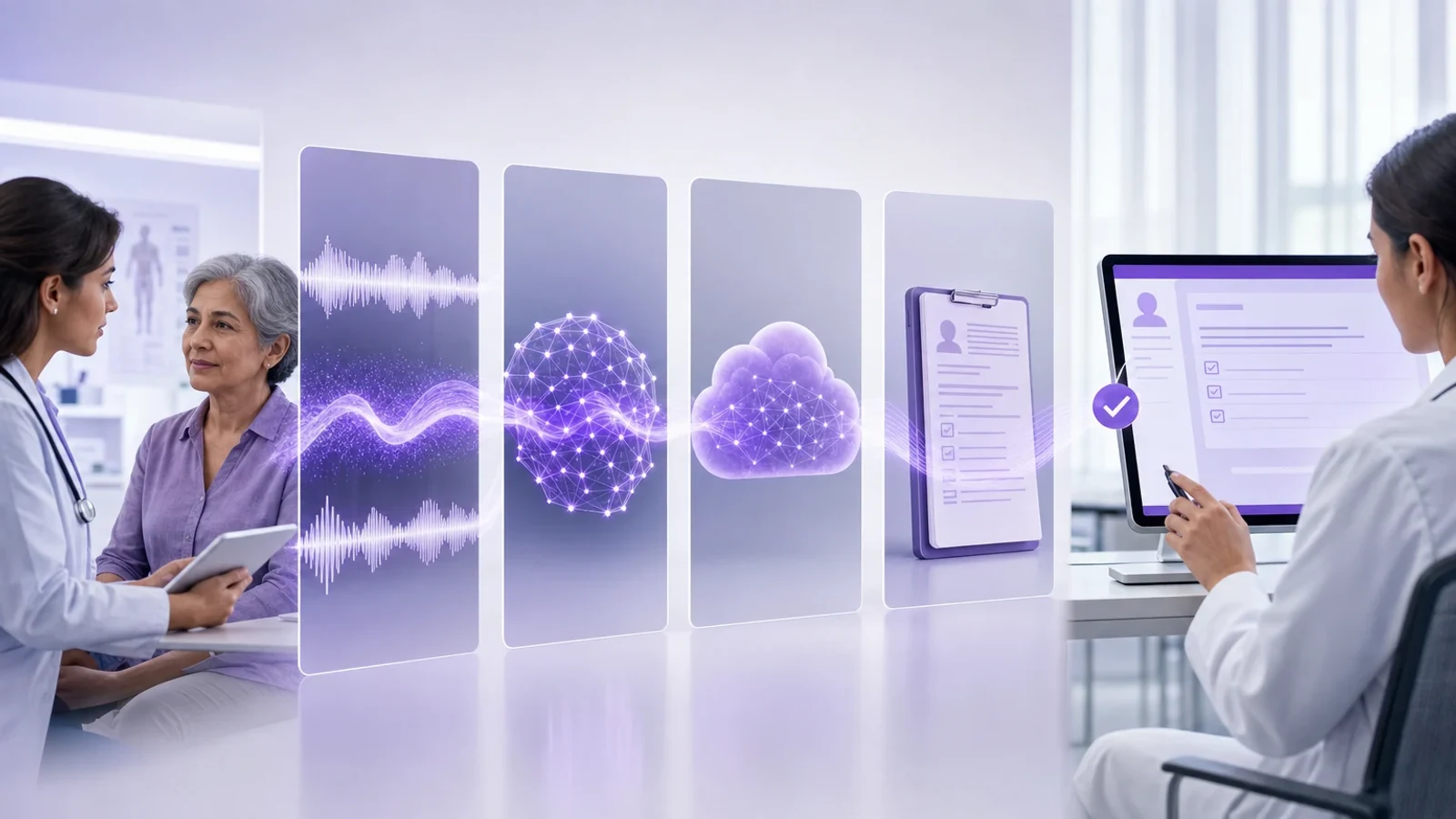
The assistant runs on Google Gemini large language models hosted on Google Cloud, combining natural language understanding sophisticated enough for dialect-rich speech with national-scale capacity. It supports patients across the care journey:
- Intake: Collecting patient information through conversation rather than forms.
- Triage: Helping patients describe symptoms and routing them to appropriate care.
- Appointment booking: Scheduling, confirming, and rescheduling visits by voice.
- Follow-up care: Checking in after treatment and supporting service enrollment.
Why Telephony Is the Deliberate Choice
Many voice AI projects target smart speakers and apps. Clalit chose differently: the assistant works over standard landlines and mobile voice networks. A patient needs no smartphone, internet connection, data plan, or digital literacy; if they can make a phone call, they can access the service.
Boaz Maoz, Managing Director of Google Cloud Israel, and Prof. Eytan Wirtheim, Director General of Clalit Health Services, lead the collaboration, pairing Google’s technical resources with Clalit’s patient expertise.
Pro tip
When evaluating voice AI for public services, ask whether it works on a basic landline. If not, you may be building accessibility for the already-connected.
Key takeaways
→ Google.org granted $2 million over two years to Clalit for the Digital Front Door voice assistant.
→ The platform runs on Google Gemini models and Google Cloud, covering intake, triage, booking, and follow-up.
→ Operating over landlines and standard voice networks means no smartphone, internet, or data plan is required.
Dialect-Tuned Speech and the Accessibility Advantage
An underappreciated barrier in digital health is language formality. Portals are written in standardized language, but everyday speech is messier: local dialects, colloquialisms, and code-switching. A patient might describe a symptom using a community phrase absent from any medical dictionary.
Clalit’s system tunes speech recognition to diverse local dialects and cultural nuances. This is not cosmetic; it is the difference between a system patients use and one they abandon. When recognition fails to understand natural speech, the result is repetition, misinterpretation, and distrust.
Why Dialect Support Is Hard
Commercial speech recognition models are typically trained on high-resource languages and standardized accents, leaving dialects underrepresented. Building dialect-aware systems requires deliberate data collection and community involvement, which is why Clalit plans to open-source its cultural adaptation framework: that hard-won knowledge may be more valuable than the model itself.
Trust matters too. A survey of 300 voice assistant users in ACM research on healthcare voice AI assistants found trust significantly explained by usefulness, content credibility, service quality relative to a professional, and security and privacy risks. A system that understands patients naturally and protects their data is more likely to be adopted at all.
Privacy and Zero-Trust Security
Healthcare voice data is among the most sensitive information a system can collect, potentially exposing identity, emotional state, and health conditions. Clalit addresses this with a zero-trust architecture that trusts no user, device, or network segment by default.
Under this framework, voice interactions are encrypted, stripped of personally identifiable information (PII), and anonymized. This matters for several reasons:
- Regulatory compliance: Frameworks such as HIPAA require protecting sensitive information from unauthorized access.
- Patient trust: People speak candidly only to systems they believe protect their information.
- AI safety: Anonymized data reduces re-identification risk if systems are breached.
Privacy is a precondition, not a bolt-on. A review of voice-enabled AI in medicine stresses that safeguarding patient data is paramount under regulations like HIPAA, and that voice data must integrate with clinical IT infrastructure and electronic medical records. Clalit’s zero-trust design builds these requirements in from day one.
Warning
Voice recordings are biometric-adjacent data. Verify that PII removal and anonymization happen before data is stored or used for model improvement, not after.
From Proprietary Tools to Open-Source Health AI
Perhaps the most consequential decision is what happens after the Israeli rollout: Clalit plans to release the voice AI architecture and cultural adaptation frameworks as open source, letting public health organizations worldwide deploy similar dialect-aware, phone-accessible solutions.
This inverts the typical model. Most clinical AI tools are proprietary products configured within vendor limits; open source makes the reference implementation, including hard parts like dialect adaptation and telephony integration, a shared public good.
What the Open-Source Release Could Enable
- Rapid replication: Health ministries can adapt the architecture rather than starting from scratch.
- Cultural localization: The framework templates tune speech recognition to new dialects.
- Cost reduction: Budget-limited systems can build on proven components.
- Community scrutiny: Open code allows independent privacy and safety audits.
The rollout follows a phased approach: an initial pilot, then nationwide scale-up across Israel. Pilots surface real-world failure modes, such as handling ambiguous symptoms or distressed callers, before national deployment multiplies the stakes.
The Challenges Voice AI in Healthcare Must Overcome
Voice AI in health care is not a solved problem. The research literature identifies persistent hurdles any deployment, including the Digital Front Door, must navigate.
Latency and Conversation Flow
Generative AI models can be computationally intensive, causing awkward pauses that break natural conversation; optimizing performance and infrastructure is critical. A related problem is turn detection: current voice activity detection remains fragile, causing premature interruptions or gaps. Integrating semantic understanding, prosodic features, and contextual inference will be essential.
Reliability and Misinformation
AI must deliver accurate information and handle speech-to-text errors to avoid adverse outcomes. The voice-enabled AI in medicine review notes that continuously maintained medical voice systems can mitigate misinformation, but this requires strict adherence to source-verifiable information. In triage, a misunderstood symptom can affect clinical outcomes.
Ethics and the Human Relationship
There are legitimate concerns about over-reliance on AI and its impact on the physician-patient relationship. The consensus is that AI should augment rather than replace human interaction, with professionals trained under clear ethical guidelines. Legal boundaries for AI decision support also remain unsettled, with frameworks like the EU AI Act expected to define AI’s role while protecting patients’ and physicians’ rights.
Note
Beyond administration, clinical speech AI research is exploring monitoring of mental health, cognitive decline, and motor disorders, though these remain emerging areas.
Lessons for Health Systems Considering Voice AI
For healthcare administrators and digital transformation teams, the Digital Front Door offers a practical playbook for a similar initiative:
How to plan a phone-accessible voice AI deployment
- Map your excluded populations first
Identify which patients cannot use existing digital channels and why: literacy, language, connectivity, device access, or age. This defines the real requirements rather than assumptions.
- Choose telephony as a baseline channel
Design the system to work over standard landlines and mobile voice networks before adding app or web channels. This guarantees the widest possible reach from day one.
- Invest in dialect and cultural adaptation
Collect speech data from the communities you serve and tune recognition to local dialects. Involve community members in testing to catch misunderstandings early.
- Build privacy in from the start
Implement a zero-trust architecture with encryption, PII removal, and anonymization applied to all voice interactions before storage or model training.
- Pilot, then scale
Run a limited pilot to surface failure modes, refine the experience, and validate clinical safety before expanding to a full population.
- Plan for knowledge sharing
Consider documenting your architecture and adaptation methods so peer organizations can benefit, accelerating inclusive AI adoption globally.
Tip: Pair every automation with a clear escalation path to a human staff member, especially for triage and emotionally sensitive calls.
The broader lesson is intent: technology choices encode values. Choosing landlines over apps, dialects over standardized language, and open source over lock-in reflects a commitment to equity that other systems can adopt with different technologies.
Frequently Asked Questions
What is the Digital Front Door voice AI assistant?
The Digital Front Door is a conversational voice AI platform developed by Clalit Health Services with a $2 million, two-year Google.org grant. It guides patients through intake, triage, booking, and follow-up over standard phone lines, powered by Google Gemini models on Google Cloud.
Who can use the Clalit voice assistant?
It works over standard landlines and mobile voice networks, so patients need no smartphone, internet access, data plan, or written literacy. It is built specifically for people excluded by traditional digital health portals.
How does the system handle patient privacy?
Clalit uses a zero-trust architecture that encrypts voice interactions, strips personally identifiable information (PII), and anonymizes them, aligning with healthcare AI requirements to protect sensitive patient data from unauthorized access.
Will the technology be available outside Israel?
Yes. After the pilot and nationwide rollout in Israel, Clalit plans to release the voice AI architecture and cultural adaptation frameworks as open source, enabling public health organizations worldwide to deploy similar dialect-aware, phone-accessible solutions.
What are the main risks of voice AI in healthcare?
Key challenges include latency and turn-detection errors, speech-to-text mistakes that could affect clinical decisions, over-reliance on AI at the expense of the physician-patient relationship, and unsettled legal boundaries for AI-based decision support.
Why is dialect support so important for healthcare voice AI?
Formal written language in portals excludes patients who communicate in spoken dialects. Tuning speech recognition to local dialects and cultural nuances makes systems understandable and trustworthy, which research links directly to adoption and trust in healthcare voice assistants.
Conclusion: A Model for Inclusive Healthcare AI
The Google.org grant to Clalit Health Services is modest in dollars. Still, significant in demonstration: a $2 million investment in a voice-first, dialect-aware, phone-accessible AI assistant shows that closing healthcare’s digital divide requires deliberate design choices that put the least-connected patient at the center.
Generative AI capability, telephony-first access, zero-trust privacy, and open-source release create a template others can follow. Challenges remain, from latency to legal clarity, but voice AI is moving from convenience to core instrument of health care equity. The key question is not which model to deploy, but who your current systems are leaving behind, and how a simple phone call could bring them back.
Check out our other articles for the Newest AI content.